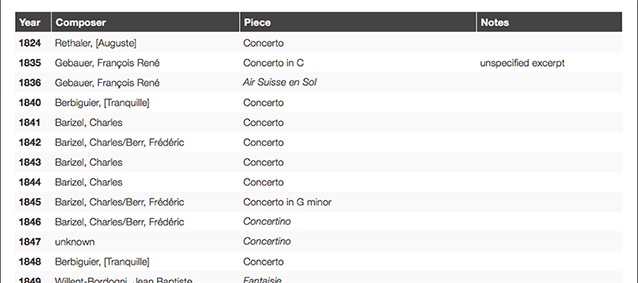
The Paris Conservatoire has, through its annual concours (contest), added a great number of works to the bassoon’s solo repertoire. Recently, I found myself wondering how many of these works have been uploaded to IMSLP. I started my search by pulling one of the great bassoon reference works off my shelf: Kristine Fletcher’s book The Paris Conservatoire and the Contest Solos for Bassoon (Bloomington, IN: Indiana University Press, 1988). I was lucky enough to buy one of Dr. Fletcher’s last extra copies when I was in grad school, but it’s difficult to get your hands on today, outside of university libraries. I made myself a spreadsheet of all the contest pieces, and set about searching IMSLP and copying links for pieces that have been posted there. Partway through this task, I realized that what I was creating had the potential to be of great use to others. So, I’m posting it on my site today.
When I initially checked IMSLP, only a dozen of these works (not counting Mozart, Vivaldi, and Weber) were available. I’ve uploaded an additional 4 pieces by Eugène Jancourt over the last week or so, and have one by Henri Büsser in process. Some of the 19th-century works may never have been published, and many of them have titles that are probably too generic for positive identification (e.g. “Concerto”). But, there are still another 20+ published works out there that are potentially in the public domain (at least in the US), and could be added. I’ll keep working to track these down and make them available. If you have original printings of any of them, please get in touch!
The table of contest pieces needs a little extra space, so I’ve put it on its own page. You can get there either via the “Resources” tab above, or simply by clicking the image of the table below:
Paris Conservatoire Contest Pieces—click to view the entire table
German composer Paul Hindemith wrote more than forty sonatas. In addition to at least one sonata for each standard orchestral woodwind, brass, and string instrument, he wrote for a number of less-common solo instruments, including the English horn, the viola d’amore, and the althorn. Although he was primarily a viola player, Hindemith owned and could play many of the instruments for which he wrote; he apparently had a particular interest in the bassoon. An entry in the Heckel visitor’s log indicates that Hindemith purchased a bassoon from the firm on October 9, 1927.2
Hindemith wrote his Sonate for bassoon in 1938, during a tumultuous time in his life. Performances of his music had been banned in Germany in 1936, and in May 1938 he was one of the composers singled out for scorn at a Nazi exhibit of Entartete (Degenerate) Musik in Düsseldorf. He soon decided to leave Germany, and emigrated to Switzerland in September 1938.3. The premiere of his Sonate for bassoon took place in Zurich on November 6 of that year, performed by bassoonist Gustav Studl and pianist Walter Frey. The concert also included his Sonata for Piano, four hands, performed by Frey and Hindemith himself.4
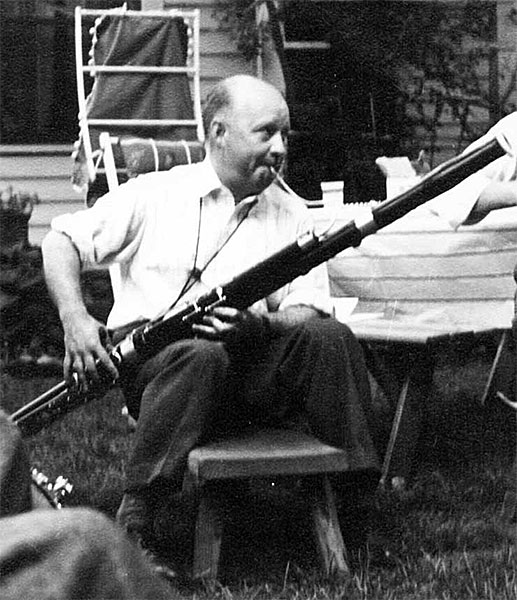
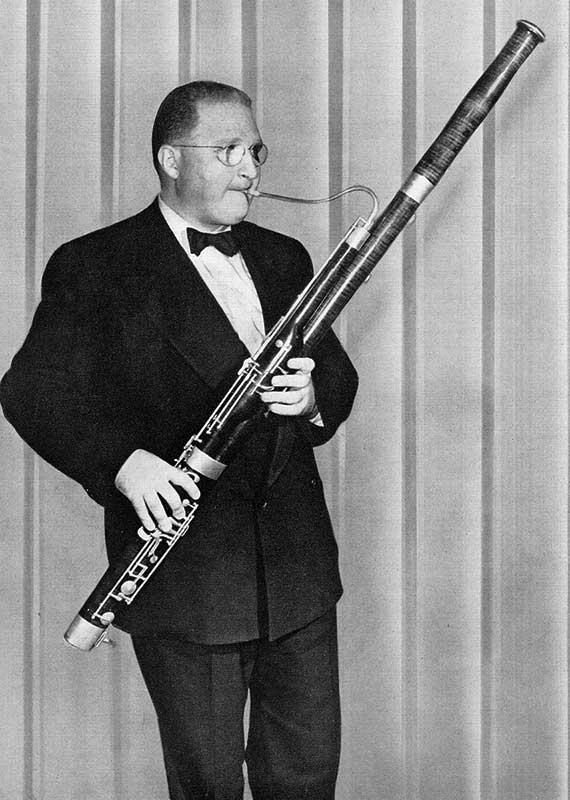
Bernard Garfield in the mid-1960s, with his black 7000-series Heckel (more info)
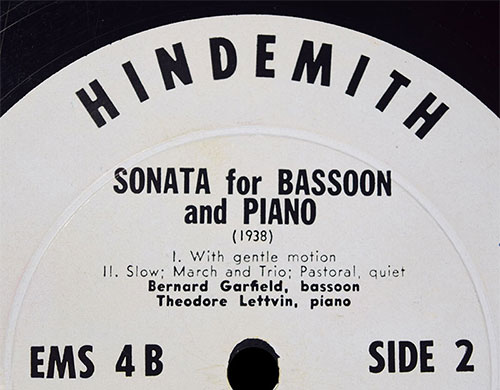
The earliest recordings of Hindemith’s bassoon Sonate were made in the United States, to which the composer had emigrated in early 1940. As far as I can tell, the very first recording of the piece was made by Bernard Garfield (with pianist Theodore Lettvin) on EMS Recordings, released in 1950. I contacted the Hindemith Institute in Frankfurt, and they confirmed that the Garfield recording is the earliest of which they’re aware. Leonard Sharrow also made an early recording of the piece for the Oxford Recording Company, probably some time in the 1950s, but I have been unable to find precise dates of recording or release.
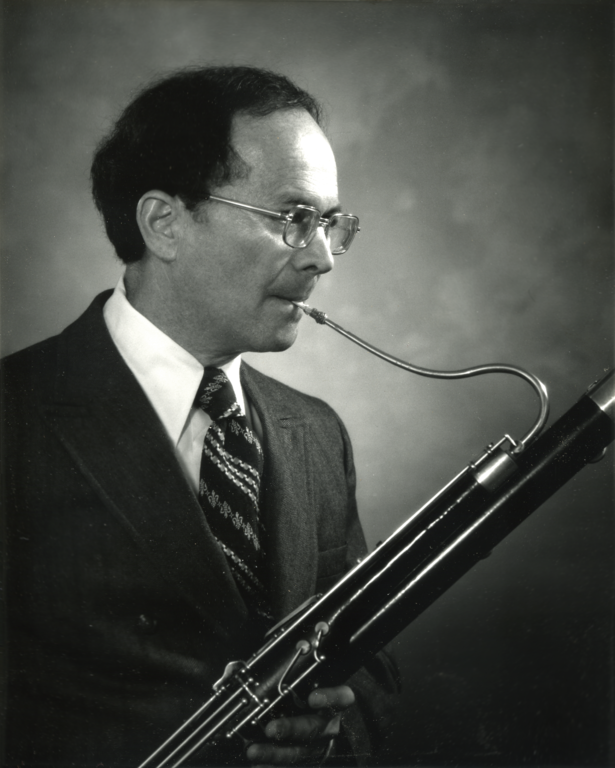
Garfield, who will turn 93 this Friday, is best known for serving as the Philadelphia Orchestra’s Principal Bassoonist from 1957 to 2000. He is one of my grandteachers — Jeffrey Lyman, with whom I studied at Arizona State, studied with him, among others. Garfield has also composed a number of works, mostly featuring the bassoon in various combinations. His recordings of some of the pillars of the bassoon repertoire are still in print, and are easily obtainable, including the Mozart Concerto and Weber Andante e Rondo Ongarese (both with Eugene Ormandy and the Philadelphia Orchestra).
But, his recording of the Hindemith Sonate has never been re-released, and is quite difficult to find (this likely has to do with the fact that the owner of EMS Recordings, Jack Skurnick, died suddenly in 1952, leaving the company’s recordings to languish). I must admit that I wasn’t even aware Garfield had made a recording of the piece until San Francisco Symphony principal bassoonist Stephen Paulson made a Facebook post about three months ago, asking about its availability. It took me quite a while to track down a copy, although unfortunately it’s a somewhat worn and crackly one. But, I’m still happy to present a digitized version here:
EDIT: According to Anthony Georgeson, Garfield acquired the 7000-series Heckel in the photo above after he made this recording; he’s using a 9000-series here.
Gunther Joppig, “Heckelphone 80 Years Old,” Journal of the International Double Reed Society 14 (1986), 73. ↩
Giselher Schubert, “Hindemith, Paul,” Grove Music Online, Oxford Music Online. Link↩
Robert Peter Koper, “A Stylistic and Performance Analysis of the Bassoon Music of Paul Hindemith,” (Ed.D. diss., University of Illinois at Urbana-Champaign, 1972), 115. ↩
Auguste Mesnard was born November 17, 1875 in Cognac, France. He began his musical career as a violinist, studying at the Ecole Nationale de Musique d’Angoulème, and earning a first prize from there in 1891. After an unsuccessful audition to enter the Paris Conservatoire, one of his musical colleagues in Angoulème suggested that he take up the bassoon instead. He evidently took to the instrument right away, as he managed to gain entry to Eugène Bourdeau’s bassoon class at the Paris Conservatoire only two years later (November 1893). He won a first prize there in 1897, and went on to bassoon positions in the Concerts Rouge, Orchestra Lamoureux, and Societé Nationale de Musique. In his position as second bassoonist with the Orchestra Lamoureux, he played the premieres of Debussy’s Nocturnes and L’Après-midi d’un faune.
In 1905, Walter Damrosch, music director of the New York Symphony Orchestra, traveled to Paris in search of principal woodwind players for his orchestra. Mesnard auditioned for Damrosch and was hired, along with flutist George Barrère, oboist Marcel Tabuteau, and clarinetist Léon Leroy. Mesnard played under Damrosch for the the 1905-08 seasons, and then took a position with the Chicago-Philadelphia Grand Opera Company. In 1912 he turned down a job with Leopold Stokowski’s Philadelphia Orchestra, but soon returned to New York to join the New York Philharmonic under Josef Stránský. Willem Mengelberg succeeded Stránský in 1922, and did not get along with Mesnard. Mesnard’s colleague Benjamin Kohon related a possible reason:
Mesnard and I were associate 1st bassoonists with the N.Y. Philharmonic Orchestra for 2 seasons under W. Mengelberg, conductor. I imagine that Mengelberg did not like the French bassoon sound and thus was picking on Mesnard. They had an argument after a rehearsal and Mesnard resigned. And I would have done the same thing if I had been treated in a similar manner.2
Mesnard’s career continued for another 20+ years, playing with the touring Wagnerian Opera Company, the Capital Theater Orchestra under Eugene Ormandy, the Roxy Theater Orchestra, and an orchestra supported by the Works Progress Administration.3 Mesnard retired in 1945 at the age of 70, and died in New York in October 1974, just shy of his 100th birthday.4
Mesnard began writing his memoirs in 1943, shortly before his retirement, and worked on them over the next decade or so. These were never published, but copies of the typescript reside in the libraries of Southern Illinois University and the International Double Reed Society. I haven’t been able to examine this yet myself, but French bassoon specialist Laurence Ibisch wrote an article about Mesnard in the October 1978 issue of The Double Reed, with information taken from the memoirs.5 Unless otherwise noted, all the information in the preceding biographical sketch comes from Ibisch’s article.
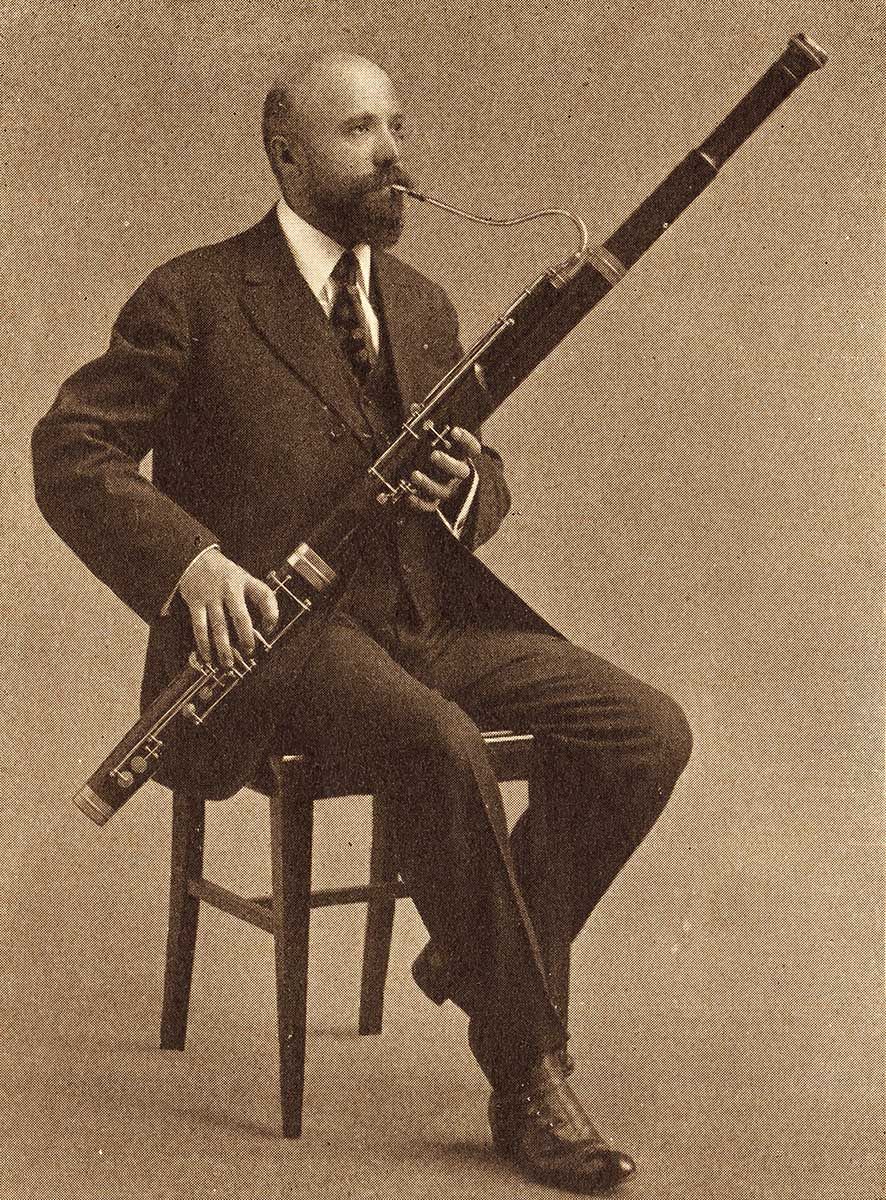
Ibisch also owns and regularly plays on Mesnard’s Buffet bassoon — the very one in the photo above.6 It was made in 1900, and has sixteen keys (rather than the 22 present on the Jancourt “perfected” system). Buffets are commonly made of rosewood, but this instrument has only a rosewood wing joint. The rest of the instrument is made of much lighter maple, which is more common for German bassoons.
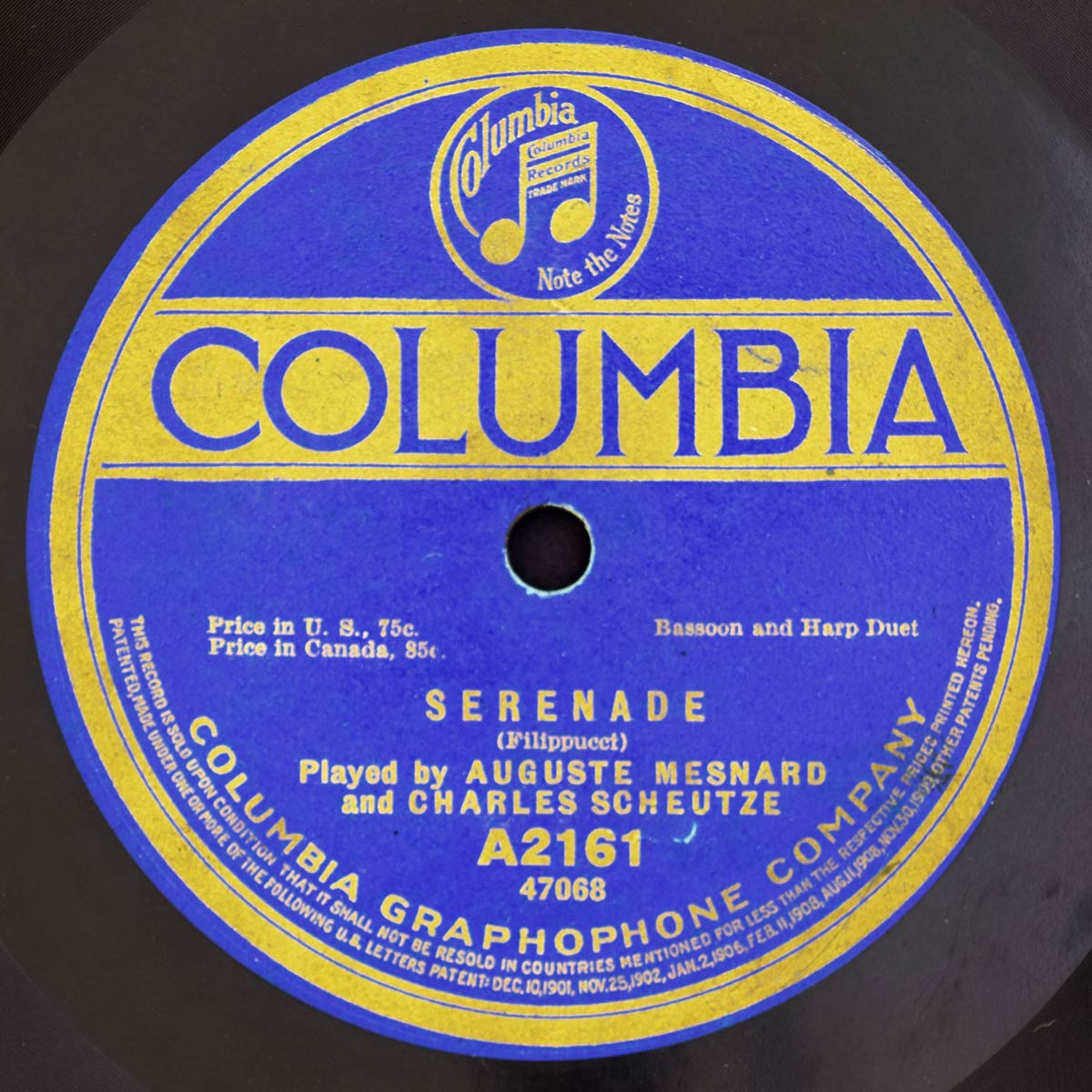
Columbia A2161
During his tenure with the New York Philharmonic, Mesnard also worked worked as a recording artist for the Columbia Gramophone Company. Recording companies in that era generally didn’t credit individual orchestra members, so it’s probably impossible to know how many ensemble recordings he participated in. His one recording as a soloist was made on October 14, 1916 — a duet with harpist Charles Schuetze. The piece they recorded, Serenade by Edmond Filippucci (1869–1948), is almost certainly an arrangement. Filippucci’s music is not easy to come by today either in printed or recorded forms, so I haven’t been able to identify the piece itself. But a likely candidate is his 2 Pièces pour violon avec accompagnement de piano: Nº 1. Sérénade, published in 1894.
Mesnard and Schuetze recorded four takes, the last of which was issued on Columbia A2161 in 1917 (backed with the Columbia Miniature Orchestra playing The Music Box).7 This is from the era of acoustic recording (no microphones), and my copy of the disc has been well-used. So, the recording has a fair amount of background noise. But, it’s still quite enjoyable. Listen to Serenade here:
While you’re listening, read this short review of the recording, published in the Bridgeport (CT) Evening Farmer in March 1917:
An extraordinary Columbia recording is a woodwind (bassoon) and harp duet: Filipucci’s “Serenade,” played by Auguste Mesnard and Charles Schuetze, solo members of the New York Philharmonic Society. A zephyr-like harp introduction is followed by a lovely interweaving of beautiful inspiring notes. The light delicate voice of the harp over the deep undertones of the bassoon is indeed eloquent of evening—shimmer-moonbeams gleaming over the shadows of night. So far as is known, the “Serenade” is the only recording extant of a harp and bassoon duet.8
Mesnard also recorded “The Elephant and the Fly” with flutist Marshall Lufsky in December 1916, but this was evidently never released.9 His colleague Benjamin Kohon recorded the same piece in 1918 for Edison Records. That version was released, and is available to stream from the UCSB Cylinder Audio Archive.
Arthur Edward Johnstone, Instruments of the Modern Symphony Orchestra: A Pictorial and Explanatory Guide for Music Lovers (New York: Carl Fischer, Inc., 1917), 32. ↩
Benjamin Kohon, “Letter to the Editor,” The Double Reed 2, 1 (1978). ↩
The Federal Music Project of the Works Progress Administration was responsible for the creation of 34 new orchestras around the country, and also supported a variety of other performance, educational, and scholarly activities related to music. Presumably, Mesnard was a member of the New York Civic Orchestra, but I haven’t yet been able to confirm this. ↩
“United States Social Security Death Index,” database, FamilySearch (https://familysearch.org/ark:/61903/1:1:VSNF-26P : 20 May 2014), Auguste Mesnard, Oct 1974; citing U.S. Social Security Administration, Death Master File, database (Alexandria, Virginia: National Technical Information Service, ongoing). ↩
Laurence Ibisch, “A French Bassoonist in the United States,” The Double Reed 1, no. 2 (October 1978): 5–7. ↩
Laurence Ibisch, e‑mail message to author, March 20, 2017. ↩
Last school year, I was lucky enough to be invited to play Mozart’s Bassoon Concerto, K. 191 with Sac State’s University Orchestra under the direction of Leo Eylar. The Mozart concerto is the piece that follows bassoonists around for their entire careers. A teacher once told me:
There are two types of auditions: ones that ask for the Mozart concerto, and ones that ask for a concerto of your choice, which means play the Mozart concerto.
I’ve worked on the Mozart concerto on and off since high school, have played it for countless auditions, and have performed it with piano accompaniment. But this was my first shot at playing it with an orchestra, and I decided to mark the occasion by writing my own cadenzas.
Mozart wrote out cadenzas for some of his piano concerti, but none for any of his wind concerti. Performers in his day would have been expected to write—or better yet, improvise—cadenzas of their own. Today, some editions of Mozart’s Bassoon Concerto come with written-out cadenzas, and many other cadenzas are published separately. Prior to last year, I had always used cadenzas written by Milan Turkovic, which are included with the Universal edition of the concerto.
My first step in creating cadenzas of my own was to examine a selection of those written by others, including Bernard Garfield, Jacques Ibert, Frank Morelli, Gabriel Pierné, and Eric Varner (all published by Trevco Music Publishing); Gernot Wolfgang (Doblinger); Milan Turkovic (Jones—not the same as the cadenzas in the Universal edition); and unpublished cadenzas by the late California bassoonist Robert Danziger. I also consulted Sarah Anne Wildey’s 2012 dissertation, which presents and analyzes cadenzas from eighteen bassoonists, including Steven Braunstein, Daryl Durran, Miles Maner, Scott Pool, William Winstead, and Wildey herself.1 Playing through and picking apart all of these helped me develop a sense of what I like (and don’t like) in a cadenza for this piece. I also listened to the twenty-five recordings that I own of the concerto (Harry Searing has catalogued more than 100 extant recordings), learning some licks along the way.
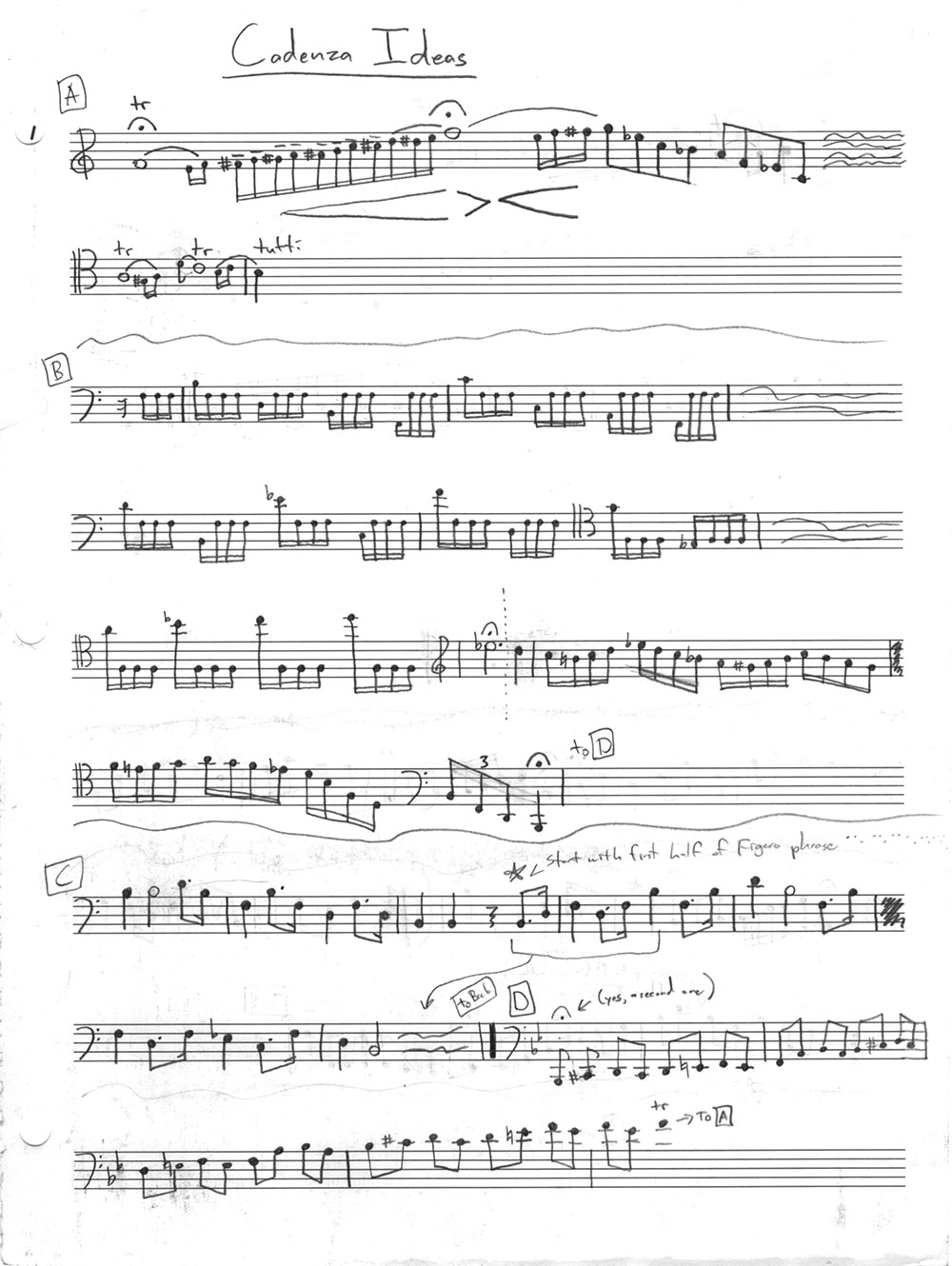
Jotting Down Cadenza Ideas
Once I’d digested all of these printed and recorded cadenzas, I set about developing some ideas of my own. I began by just improvising in B‑flat major in a pseudo-Mozartean style during breaks from practicing the concerto proper. When I came up with a chunk of music I liked, I’d write it down. After a few weeks of practice sessions, I had about three pages’ worth of melodic chunks, but they weren’t in any particular order. It took me quite a bit longer to figure out which of these would fit together in what order, to tweak them a bit, and to come up with some extra bits of musical material to glue them together. I didn’t actually write out the cadenzas in their complete form until a couple of days before the performance! But all of time I’d spent working on them made it easy for me to play them from memory in the concert.
In writing my cadenzas, I had three goals:
reference melodic material from the concerto itself
quote musical material from elsewhere
show off some of my strengths
In the first movement cadenza, I took care of goal #1 right away: it begins with a modified version of the concerto’s opening motive, moves to the dominant, goes through another version of the opening motive, and then returns to the tonic. (Only later did I realize that the first few measures of this are similar to the first few measures of the other published set of Milan Turkovic’s cadenzas). The very next passage fulfills goal #2; it’s a quotation from the aria “Non più andrai,” from Mozart’s opera Le Nozzi di Figaro:
Top: the opening of Figaro’s aria “Non più andrai“2 — Bottom: MM. 8–17 of my mvt. 1 cadenza
The second half of this passage is almost the inversion of my modified version of the opening motive of the concerto, and complements it well. Also, it seemed fitting to quote this here because the concerto already has a connection to the opera: Mozart later reused the opening motive of the second movement in the aria “Porgi amor.” “Non più andrai” (sung by Figaro) is the last aria in Act I of Le Nozzi di Figaro, while “Porgi amor” (sung by the Countess) is the first aria in Act II. So, this is my own little nod to Mozart’s self-borrowing.
A second quotation in the mvt. 1 cadenza allowed me to hit all three goals: it is based on a passage from the Turkovic cadenza I’d used previously (goal #2), it draws on material from the concerto itself (goal #1), and it allows me to show off two of my strengths: fast tonguing and high register facility (goal #3). I always felt a little restricted in Turkovic’s version of this passage—it’s meant to accelerate, but it’s also too short to build up the kind of speed I wanted. For my version I extended it by seven beats, which also allowed me to push much higher in the bassoon’s range.
MM. 24–28 of my mvt. 1 cadenza. The beginning of this passage is taken from one of Milan Turkovic’s cadenzas; I extended it by seven beats to end on E‑flat instead of F.
There’s actually yet another level of quotation going on here; Turkovic took this passage from a cadenza written by Romanian-Viennese musicologist and composer Eusebius Mandyczewski (1857–1929). So, I’m quoting Turkovic quoting Mandyczewski paraphrasing Mozart.
The first idea I jotted down was an ending for my mvt. 1 cadenza (shown below), and I don’t think it ever changed. This passage is solidly in the pursuit of showing off my high range (goal #3), and as such doesn’t strictly fit within period-appropriate performance practice.3 But even if it goes higher than bassoonists in Mozart’s time were likely to have played, I feel that it’s in the spirit of cadenzas as vehicles for showing off.
The ending of my Mvt. 1 cadenza, and the first idea I wrote down. I knew I wanted that high G!
This passage works chromatically up to an extended high F (top of the treble clef staff). And just when you think that’s high enough, it continues up chromatically to G. In performance I added to the deception by putting a long decrescendo on the F, as if fading away, before coming back up to forte to continue up to G. In the written-out version of my cadenzas (downloadable below), I’ve provided an alternate ending for those who’d rather avoid the high G.
Watch the first movement cadenza:
My process for writing the second movement cadenza was much the same. But in keeping with the movement’s character, I focused on beauty much more than virtuosity. Also, not wanting to go overboard with quotation, I used only one motive from the concerto itself and didn’t quote any other works.
MM. 4–7 of my mvt. 2 cadenza
The end of this passage comes from the movement’s recapitulation, although I’ve taken it down an octave here. I use the same motive, modified only so that it descends every time, to get there from what had come before.
As far as I know, the rest of my Mvt. 2 cadenza is original material (although it’s certainly possible that parts of it were unconsciously inspired by some of the many cadenzas I read through at the beginning of my process). Here’s the second movement cadenza:
Download the Cadenzas
If you’d like to try my cadenzas out for yourself, you can download a PDF below. If you use them in performance, please let me know!
Sarah Anne Wildey, “Historical Performance Practice in Cadenzas for Mozart’s Concerto for Bassoon, K. 191 (186e)” (DMA Diss., University of Iowa, 2012). ↩
A 1780 fingering chart by bassoonist Pierre Cugnier goes up to high F, but there’s little evidence for anyone playing stratospheric notes in performance before Carl Almenräder in the early nineteenth century. ↩
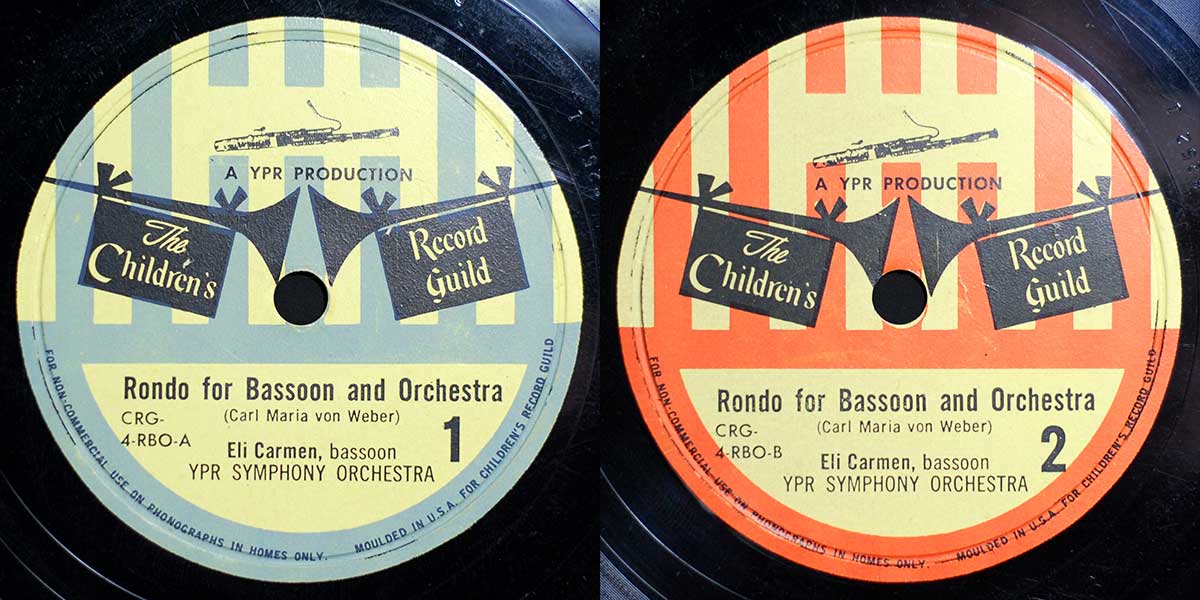
I’ve written previously about the three earliest recordings of Carl Maria von Weber’s Andante and Hungarian Rondo — two featuring German-American bassoonist William Gruner (1920 and 1926), and one with French bassoonist Fernand Oubradous (1938). As a number of people pointed out, I left out another early recording by Eli Carmen from the late 40s. I didn’t have a copy at the time, but I’ve managed to get my hands on one now. This one’s a bit of an oddball: it’s only the Rondo, it was recorded for a children’s record label, and it was released on a vinyl 78rpm disc. As far as I can tell, this recording has never been rereleased, but you can listen to it below.
Both labels of my disc — a later Children’s Record Guild release, originally recorded for Young People’s Records. Click for a larger version.
Eli Carmen
Elias Carmen was born in New York in 1912 to Russian immigrant parents. His father was a tailor.1 He started on the French system, but switched to the German bassoon when he began studies with Simon Kovar. Carmen and Sol Schoenbach were the first two German bassoon students at Juilliard.2 Carmen played with many orchestras during his carer, most notably the Minneapolis Symphony, the Cleveland Orchestra, the NBC Symphony, and the New York City Ballet. He taught at both the Manhattan School of Music and Yale. Carmen died following an auto accident on December 21, 1973.3
Carmen appeared on a great number of orchestral recordings with the NBC Symphony, as well as recordings of chamber music by Beethoven, Ludwig Spohr, Arthur Berger, and Mel Powell. He also recorded Vivaldi’s Concerto in G minor, “La Notte” with flutist Julius Baker on Odyssey.4 But this partial Weber is his only truly solo recording.
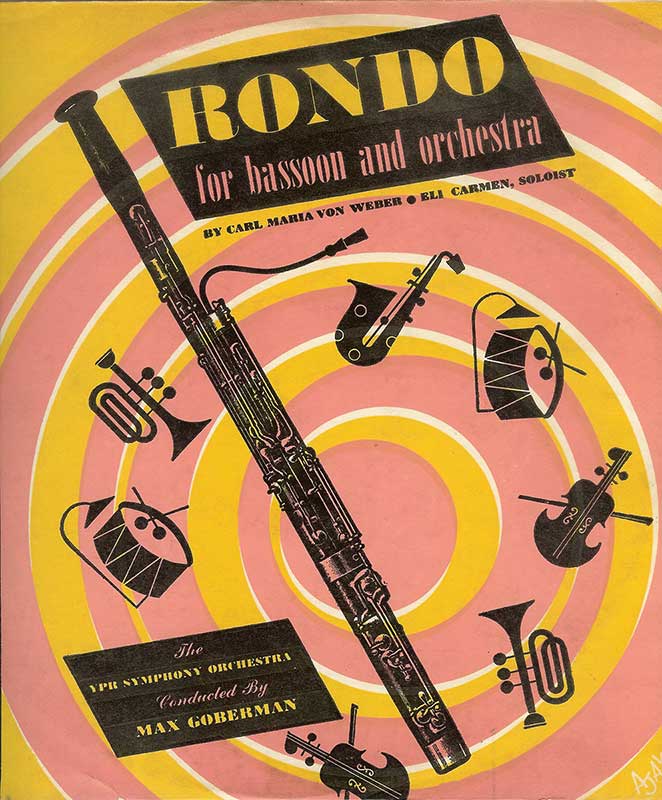
YPR 1009 Cover
Young People’s Records was established in the late 1940s, and sold records on a subscription model. Existing children’s records were meant to be played for children by their parents or teachers. But YPR wanted kids (ages 2 to 11) to actually use the records themselves. To this end, YPR was one of the first companies to exclusively use the then-new flexible vinylite for their discs, rather than the older and much more fragile shellac. A large quantity of the recorded material was written specifically for YPR — mainly songs in various styles, but also instrumental works and even mini-operas. YPR’s editorial board, which included eminent American composers and teachers Howard Hanson and Douglas Moore, no doubt encouraged the prevalence of new commissions. Recordings of Classical or Romantic composers, such as Weber, comprised a relatively small portion of YPR’s catalog.5
Records of YPR’s recording session dates evidently haven’t survived, but Eli Carmen’s Rondo was released in November 1949. Max Goberman conducted this and YPR’s other classical selections, and what’s billed here as the “YPR Symphony Orchestra” was assembled largely from Goberman’s own New York Sinfonietta. YPR emphasized music’s educational and developmental benefits in both its advertising and its packaging. The text on this record’s sleeve give a kid-friendly explanation of Rondo form:
Rondo for Bassoon and Orchestra by Carl Maria Von Weber (pronounced Fon Vaber) 1786 — 1826
When you tell an idea in words, it is called a story. When you tell an idea in music, it is called a melody. Just as you can tell a story in many different ways, so you can tell a melody in many different ways — and one of those ways is a rondo. (Other ways are marches, different kinds of dances, sonatas, sets of variations. None of these ways of telling a melody have words or stories attached to them.)
The rondo way of telling musical ideas is to keep coming back to the first idea, or melody. In this rondo — its full name is Hungarian Rondo for Bassoon and Orchestra — we hear a melody, then a new melody, then the first melody, then another new melody, then the first melody again. Sometimes these melodies are played by the bassoon alone, sometimes by the orchestra alone and sometimes by bassoon and orchestra.
And a further note “To Parents” explains why this particular work was chosen for the series:
…Young People’s Records believes the rondo to be a good form for children’s listening because it is readily apparent and acceptable. The recurrence of a basic melody is something the child can easily follow without becoming lost in intricate problems of design and form. We have chosen this particular rondo for children because of the appeal of the bassoon as an instrument.…
Hear Eli Carmen’s Rondo here:
For more about Young People’s Records and the Children’s Record Guild, see David Bonner’s 2008 book Revolutionizing Children’s Records and his web site: yprcrg.blogspot.com. The Shellackophile has also digitized and posted a number of YPR titles, which you can download (thanks to him for the image of the cover above, as it’s missing from my disc).
1920 United States Federal Census, Brooklyn Assembly District 2, Kings, New York (Washington, D.C.: National Archives and Records Administration, microfilm publication T625, roll T625_1146, page 6A). ↩
David Bonner, Revolutionizing Children’s Records: The Young People’s Records and Children’s Record Guild Series, 1946—1977 (Lanham, MD: Scarecrow Press, 2008). ↩